Before you play
- Follow the device maker's liquid-safety guidance first. Do not charge a wet connector.
- Disconnect headphones and Bluetooth speakers so audio uses the wet phone speaker.
- Remove the case if it blocks the grille and hold the speaker facing down.
- Begin at a moderate media volume. Play the 30-second file once, then compare the speaker with familiar speech or music.
- Stop if the phone heats up, distorts sharply, shows a liquid warning, or appears internally wet.
For guided playback with a before-and-after comparison, use the browser tool. For a laptop, follow the laptop speaker guide instead of assuming this phone routine applies.
How these files were made
Each file repeats the same sine-wave sweep: 165 Hz to 230 Hz in 2.5 seconds, then back to 165 Hz in 2.5 seconds. The 30-second file matches the homepage default; 60 and 90 seconds only repeat it longer. The files are mono, 16-bit PCM WAV at 22.05 kHz, with no speech, tracking tags or third-party audio. The signal amplitude is 24% of full scale with a short fade at the beginning and end.
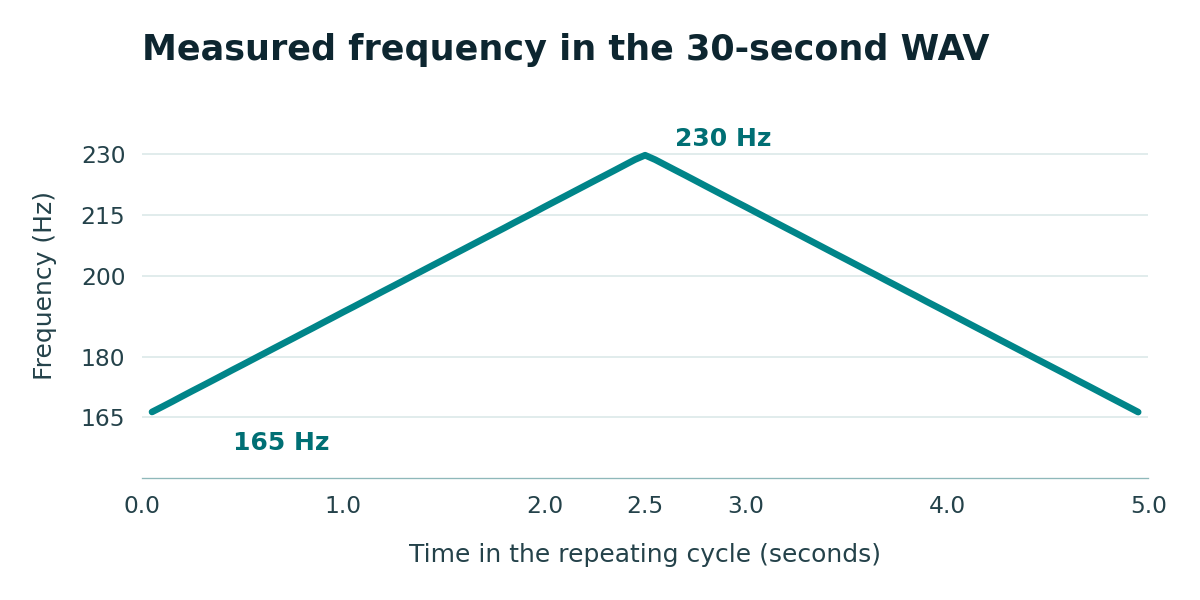
These settings describe our product; they are not a scientifically established optimum for every speaker. Phone hardware, grille geometry, liquid location, case design, and damage all vary.
Why a sweep instead of a fixed 165 Hz tone?
Many search results label 165 Hz as the water-eject frequency, but we found no manufacturer source or controlled comparison establishing it as a universal optimum. This download includes 165 Hz as the lower end of a transparent sweep; it does not claim that 165 Hz alone is special. See the frequency evidence and limits for the source boundaries.
WAV rather than MP3
WAV stores the generated waveform without lossy compression and is widely supported by current phones and computers. The larger file size is the tradeoff. We publish the format and settings so the asset can be inspected instead of describing it as a secret or universally calibrated frequency, which is the main difference compared with speaker cleaner apps.
If you only need to use the sound once, play the browser version without downloading a file, or read how to play it on an iPhone or on Android.